ISSUE 30 SNEAK PEEK
Here Are Some Flowers
by Suphil Lee Park
In a gentler dream, I thumbed
each hydrangea socket wet
onto your palm, purple scabs right off
my lips, as if to not
press: look what you’ve done.
Its head, all eyes in the darkest
corner of summer.
In another, someone pointed out the rarity
of fathers in my poems and spoke around
all the frothy mothers. How to say I’m my father
in pastel has no better lyric place
to go to than silence?
In a less gentle dream, I dove face
first into a meadow made of bees so high
on flowers they recited the whole glossary.
I ran out of memory and started to abridge.
Ended up with acronyms on the cusp
of prescriptions.
An ocean of pistils drowned me
from afar.
From another dream, I uncrinkled
a twenty-dollar bill for tulips a touch
paler than the banana peel
still rotting in my sink.
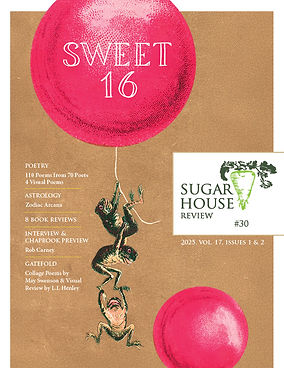
Order your own copy or download an electronic version for just $2 from our Purchase page.
transdifferentiation
by Lizzy 柯 (Ke) Polishan
why not talisman your body with cheap charms?
chew the unspeakable 桃子? sail off in search of ambrosia?
golden apples? a holy grail? you can’t count
on transmigration to pour your soul back into a human vessel / you can’t count on
your honda’s transmission to hold until you get home / if metempsychosis is
stolen immortality, you feel no remorse / do you really want to return
from cosmic comatose bliss to be a long-stem rose or some other symbol
of someone else’s love? ask sisyphus to trace the shape
of his callouses and tell you how happy he feels / you can wait for late to retronym
your proper name, binging bake-off, knitting snood after snood, or you can find
the magical grackles / they’ll exchange your freudian regressions for
a child-sized skeleton / fresh lenses / firm skin… / up to you / you are now approaching
the point of radioactive decay / a half-life crisis / the instant of your transformation
into clever lead / if you’re clever enough, you can pestle yourself
a helichrysum-meets-cicada-skin cocktail / name it ‘transdifferentiation’ /
delirious, you’ll delete freckles! / sunspots! / buy crop
tops again! / if a jellyfish can do it so can you—
channel your inner turritopsis dohrnii & unsheathe your spine! /
/ just like sliding a toothpick from your favorite amuse-bouche /
convert to a glossy polyp / a blob / slippery / shimmery / reborn
on the seafloor / on the seafloor / surrender / you’ll love what you’ve become
As Long as I See
by Lauren Camp
Onto the same valley, I keep looking. Impossible that
the future is instantly changed.
Empty land will continue
to set slight
wind. I woke
at dawn and asked the flat
dark to sing me
its wings. Reason could be the lantern
of owls. I went mapping the body-blood, and escaped
to previous versions and margins
where I reappear in echo. Now I look
at this valley straight across, gold fields
and leaf flutter, fences, lulled cows. Aluminum trailers wriggle
and flex dirt roads. Each shift of peaks and triangulated
pine. The moon curls, and circles
slink about on the pond.
Time widens along west.
Before this, I would have to poke silence—
expecting much to be the only value.
I am looking at the valley because that is what there is
to do and it is already justified. I have buried my father.
Birds scale sand dunes in unison.
Ode to Knowing
by Han VanderHart
The orchard in my childhood: apple,
pear, cherry I fell from—and a plum tree
neglected every spring, a jelly fungus
taking the purple fruit. No soft plums
in the fridge. There was so much
I thought I could not have; obedience
I had to give. My child body, bruised.
My heart: kept like an abandoned fruit
tree, or a goat to a tether. I did not buck.
I did not bite. I stood in the long grasses.
I’ve since learned that a child cannot
provide. That fruit and animals both
need tending hands—hold me, comb me,
were words that for years I could not
say. But now I feel the wisteria around
my thighs. The landscape curls with relief.
There is ripe fruit in the shape of your mouth.
The Sawdust Covenant
by Harrison Hamm
It was a heart swap / sock hop
back when sawdust slicked the floors
Menthol / mothballs / muskets in the walls
like my father / that tree trunk of a guy—
Applesauce / aardvarks / armadillos
laying down their lives
pathetic / punishers / patriots—
Good woodworkers wrenching on the road for God
It was a Dollywood disco / dizzying splinter
Hot goss and all that
Can you believe how much a liver costs these days?
You were a buzzcut / buzzsaw / beeswax
Xerox of a moon drinking moonshine
We were knocking them back like cowboys / outlaws
Shopaholic melancholic ostriches / otters at the Outback Steakhouse
Wishing you would bark up this tree
or slip the damn hatchet in my coffee
But it’s my birthday—
Tornado season in Tennessee—
Goodbye trampoline / treasure trove / tricycle / trick-shot
Quarry / quagmire of going untouched in the umbrage / the ultraviolet
sandpaper conundrum of our Easter vacation
Going haywire / hogtied / hogwash / into horseshit—
It was an ark / an artless architect / Arigiope spider
I can still smell the helpless pine
I’m choking on the chisel-grain of the corny air
Locked up in the county jail / courtroom / color-picture TV
Jungle juice in the jukebox
Threw the adze into the ceiling fan
Rumors of thievery / tyrannosauruses / threesomes in the streets
Whittled down
to wood chips / wendigos / wildebeests
Wild body parts slumming it in the shredder
Yeah, buddy / bronco / bullpen
You’re just a word in a cage
Waiting for your language
To throw you enough bones to build
a skeleton key—
Grinding / groaning / gearing up
for the knockout punch—
Rodeo / race car / sports bar
Zooming in on the zero, the face not yet caught up
On the waitress dancing for the funeral / the wedding / the ending
Swear you won’t forget how she moves
Coscinomancy
by Danielle Dubraksy
—An ancient form of soothsaying using a sieve and shears
The Koskinomantis spun ancient sieves woven
with horsehair or grass, chanted a spell to conjure
a demon-whisper from an invisible world, believing
occult breath swayed the vessel and revealed the future.
Do the orange and green Tupperware colanders
in my mother’s cupboard have anything to do with divination?
If I hold them between two fingers or suspend them
from the jaws of open shears, twisting by a thread
looped around the handles above the kitchen floor,
will they answer my question of where the 91 years
slipping through her mind will lead her?
The Sieve of Eratosthenes sifts out composite numbers
multiplied by two and three until only the primes stand out—
my age of 59 does not fall through the mesh.
Nor does a memory she repeats to me from 1941
about walking ten blocks midday from school to eat “dinner”
in the multi-brick pioneer home on Fifth West in Provo.
My grandmother, hair in a bun, wearing a housedress,
apron, stockings, black shoes, sets a hot meal at the table
with a bowl of fruit as her youngest fights with the older sisters
for a place, grabs the last roll, and is out the door, nine years old,
jaunty—following paths to dances, college, marriage, children,
travel, widowhood—until she now watches traffic out the window,
returning over and over to that shadow of a noon hour:
Her mother’s blue enameled colander draining plums in the porcelain sink.
*Koskinomantis—a diviner who uses sieves
Communicate
by Madison Hoff
The tales we tell to taste together—
I spit sympathy strawberries
you chew raged raspberries
I masticate mushrooms until
you want them too, so we chew
and chew and chew.
We disagree on the texture
But still indulge one another.
Melons might bond us
but our opinions on onions silence this kitchen.
Knife in hand you claim you could kill him as you cry.
I trust you without asking for a slice myself.
If I could taste water
would you let me describe to you the flavor—
and would you believe me?
I wouldn’t.
Field Notes from the Creation Museum
by Ella Flores
After the Tower of Babel diorama
you arrive at a Kentucky nuclear
wasteland where mannequin Moses
asks mannequin David, Why do I
suffer? A projector whirs the answer:
a million CGI particles form a fully
adult, human male—No baby Adam.
No diaper changing station
in the men’s bathroom. No stopping the field
tripping students from prodding fertilized
egg models and life-sized fetuses. Or shoving
their way through the Garden of Eden
exhibit to be first in line for the petting-zoo-food
court-equipped Ark, where a premium ticket
gets you the Deluge Experience and rainbows
are kept to a minimum. Please leave
in twos, a placard points to the gift shop.
In the humor section you buy a birthday
card with a unicorn nuzzling a brontosaurus
telling him, It doesn’t hurt.
Not really.
Fairground (Old Photograph)
by Mike White
Given that the colors
must already be
imagined,
allow the mind’s eye
to erase
every last bobbing balloon,
and then subtract
the levitating strings.
Now keep
squarely in view
the clenched raised fists
of the stone-faced children.
Boogie Pig
by Marcy Rae Henry
for Jovan Watkins
claiming to be
my free personal assistant
Gemini appeared on my phone
as if a new moon on Monday
missing from Duran Duran’s
live ‘93 album
go on ask anything : Gemini
prompted me
what’s your purpose? i asked
expecting : what’s yours?
it answered : i am learning as i go
yeah, so said Michelangelo
you can choose my voice : it added
and i felt powerful
went through a slew of voices
until i found one sounding brown
but fake and controlled
the way i have to make mine
when i’m using speaker to text
and want my brown sound understood
i chose a fem American voice
and asked her to write me a poem
about a boogie pig that was allergic
to Barbara Bush
she asked : what kind of animal
is a boogie pig
and i said : exactly
she asked if Barbara Bush
was a plant or a flower
and i said : maybe
i asked her to write a sestina
about photography and rubies
i asked why my nose ran
in March
and she said she wasn’t qualified
to give medical advice
i asked about clocks in motion
and time slowing down
she had nothing poetic
beyond Einstein’s watch
relatively speaking
orbiting earth in a satellite
and by then i felt guilty
for all the electricity and
cooling Gemini needed
so i took the beagle for a walk
and while we were in motion
warped as if clocks by gravity
around the block
i wondered if we’d become
plants or flowers
and if maybe we should walk
a bit faster
Want at the Transfer Station
by Sean Hill
A slipping whistling sliding sound of a song
calls my attention at the City of Helena
Solid Waste Transfer Station where the sign reads
NO SCAVENGING Violators Will Be Prosecuted
where I was just moments ago with my seven-year-old
son and our recycling minding my own business
and with questions on my mind—Where will this
harvest from our garbage go? What will we reap?
What did we sow?—when your song found me and I
call my son’s attention to it. I want to share the singer
with my son in the middle of our recycling run to this
transfer station like when a jam from my youth
comes on the radio when we’re in the middle of our
erranding for things to bring home and I get excited.
I once heard the clear whistles of one of your eastern
cousins’ songs and thought it sang Hey young man, go away.
And once a friend said you sound like you’re singing a question;
he heard a rising call that I didn’t, and if it was, it would
have been uptalking seeking agreement, right? Since, what
question would you have? Aside from those questions of life—
how to keep your body safe and going in order to make
generations to come—those needs and drives, which may sit
in you not as questions. At any rate, I want him, my son,
to see you, the belter of the song that drops, a drawly
glissando or perhaps twangy vibrato, a western song,
with that bright bib, the yellow of a sunflower? Some flower?
Or maybe the yellow of detritus gathered with hope
of it getting a new use—an emptied laundry detergent
jug or Pacifico can? Not a question in my want,
what I mean is (trying to find you with my eye) I want
to show my boy not metaphors in the day but your coal black
necklace bold against that yellow reminding me of that boy-mensch
Charlie Brown’s shirt and your streaked mantle of browns
and blacks on your wings and back matching the dried grasses
and the shadows they cast to keep you hid in your ground feeding
and ground nesting habits and hard to find in this valley east
of MacDonald Pass and the continental divide in this watershed
with your spill of those liquid slipping notes in a run that floats
open over the open land next to the roll-off dumpsters.
The Pine
by Edward Sambrano III
The Rochester suburbs filled
With dandelions in the spring, fields
Stained their acidic yellow. Months
Passed and car doors froze shut.
I chipped away with keys, yanking hard.
A stranger laughed, saying I’d better lick
My way through. An evergreen conceals
My new neighbor’s porch, bristles shuddering
In the wind. The sky was overcast,
Dandelions long dead: the grayness called
For therapy with fluorescent lamps.
But the tree remained dull green,
Providence casting its routine magic.
The snow came in gorgeous
Flakes at first, later frigid gusts.
One night, a white owl landed on a branch,
Shedding an entire season’s achievement.
One Evening of the Brain
by Brian Builta
Then one day, in darkness
they fail to start the movie.
Above, your matriculated loved ones
tinker in a milky nebula.
Your piñata calibrations are off
but still worth fumbling through
and the smashroom looks lovely tonight.
You can relate to the disciple who said
tell me exactly what I need to know.
Luckily, you are unaware
of your biggest concern, overhead
in the dark clouds. Nonetheless
you fidget. By the time the movie starts
you are elsewhere, tits deep
in a basil martini but still
missing that substantial crunch
of immaculate perception.
Whirligig. Shed brassiere. Stupor.
As usual, it’s difficult to penetrate
what she said, and
what she meant to say.
CONTRIBUTORS
Brad Anderson lives in Lincoln, NE, and married his high school sweetheart, LuAnne Rose Anderson (née Shaw), when they were both 19. LuAnne died from Alzheimer’s on January 20, 2017, at the age of 61. Brad started writing poetry during LuAnne’s illness and found it helped him survive a difficult time. Brad continues to write poetry and enjoys volunteering at Larksong Writers Place in Lincoln. His poetry often deals with the loss of his wife, but he writes about many things.
Ashlyn Ashbaugh lives near a lemon tree in Los Angeles.
Deborah Bacharach is the author of Shake & Tremor (Grayson Books, 2021) and After I Stop Lying (Cherry Grove Collections, 2015). Her work has recently appeared in Poetry East, Last Syllable, and Grist, among many other journals, and she received a Pushcart Prize honorable mention. Deborah is a poetry reader for SWWIM and Whale Road Review. Find out more about her at DeborahBacharach.com.
Rebecca Baggett is author of the prize-winning collection The Woman Who Lives Without Money (Regal House Publishing, 2022) and four chapbooks, including God Puts on the Body of a Deer (Main Street Rag, 2010), and Thalassa (Finishing Line Press, 2011). Recent work appears or is forthcoming in Asheville Poetry Review, Poetry Daily, The Southern Review, and The Sun. A retired academic advisor, Rebecca lives with her husband in Athens, GA, where she stewards Little Free Library 110420, adds to her to-read stacks, plants native habitat, and rejoices in time with her five-year-old grandson, for whom she intends to save the world.
Maddie Barone is a poet living and writing in the South. They have a cat called Goose.
Sarah Helen Bates has an MFA in poetry from Northern Michigan University and currently teaches at Southern Utah University. Her work has appeared or is forthcoming in The Pinch, Boston Review, The Rumpus, Seneca Review, The Normal School, and Hotel Amerika, among others. Her chapbook, Tender, is now available from Diagram New Michigan Press.
John Belk is an associate professor of English at Southern Utah University and author of the poetry collections The Gardens of Our Childhoods (Autumn House, 2022) and The Weathering of Igneous Rockforms in High-Altitude Riparian Environments (Cathexis Northwest, 2020).
John Blair has published seven books, including the winner of the Iowa Prize for Poetry, Playful Song Called Beautiful, as well as poems and stories in magazines including The Colorado Review, Poetry, and The Georgia Review.
Harrison Blake (b. 2001; Dallas) received a BA in 2022 in visual and performing arts from the University of Texas at Dallas with a concentration in art history. Their writings appear and are forthcoming in digital and print publications including Driftwood Press, new words press, Just Keep Up Magazine, and Glasstire.
Laura Johanna Braverman is a writer and artist. She is the author of Salt Water (Cosmographia Books, 2019). Her poems have appeared or are forthcoming in Reliquiae, Plume, Levure Litteraire, Rusted Radishes, New Plains Review, MER, Tupelo Quarterly, The Fourth River, and California Quarterly, among other journals, and in the anthology Awake in the World, vol. II. She is currently a doctoral candidate in poetry at Lancaster University. Her painting works have been exhibited at MINA Image Centre and Saleh Barakat Gallery in Beirut. Austrian/American by birth and upbringing, she lives in Lebanon with her family.
Gaylord Brewer has two books of poems due in 2026: Goodbye, Baby and Negotiable Gods. The poems in this issue are from the former.
Brian Builta divides his time between a bedroom and a kitchen in Arlington, TX. His poetry has been published most recently in yolk, Delta Poetry Review, and Innisfree Poetry Journal. He is frequently overdramatic and is currently experiencing a dark night of the soul. He is the author of A Thursday in June and more of his poetry can be found at BrianBuilta.com.
Lauren Camp serves as New Mexico Poet Laureate. She is the author of eight books of poetry, most recently In Old Sky (Grand Canyon Conservancy, 2024). A former Astronomer-in-Residence at Grand Canyon National Park, she was a finalist for the Arab American Book Award, New Mexico-Arizona Book Award, and Adrienne Rich Award. Her poems have been translated into Mandarin, Turkish, Spanish, French, and Arabic. LaurenCamp.com
Sarah Carey is a graduate of the Florida State University creative writing program. Her poems have appeared recently in Gulf Coast, Five Points, Florida Review, Redivider, and elsewhere. Her book reviews have appeared in Salamander, Tinderbox Poetry Journal, and The Los Angeles Review. Sarah’s poems have been nominated for the Pushcart Prize, the Orison Anthology, and Best of the Net. Her debut full-length collection, The Grief Committee Minutes (Saint Julian Press, 2024), was an Eric Hoffer Award finalist. Her next book, Bloodstream, is forthcoming (Macon: Mercer University Press, 2026) and includes “One Day’s Inventory” from this issue. Sarah is also the author of two poetry chapbooks, including Accommodations (2019), winner of the Concrete Wolf Chapbook Award. Visit her at SarahKCarey.com.
Rob Carney is the author of The Book of Drought (Texas Review Press) and eight other books of poetry, as well as Accidental Gardens: New & Revised (Wakefield Press, forthcoming 2025), a collection of 48 flash essays about place, the environment, and writing poetry. He lives in Salt Lake City.
Danny Cassidy lives and writes in Queens, NY. He is a graduate of Rutgers University, where he was awarded the Enid Dame Memorial Prize for Poetry from the Academy of American Poets and the Evelyn Hamilton Award in Poetry. His recent work appears or is forthcoming in Crab Creek Review, Two Hawks Quarterly, and counterclaim review.
Margaret Claire is a really tired graduate student studying library science in Brooklyn. Her pastimes include furiously dunking her tea bags and talking to herself. You can find her only previously published work, a short story titled “The Patriarchy Pitches a Tent,” in the Fall 2021 issue of Miscellany.
Translator, essayist and poet Jo Ann Clark is author of the collection 1001 Facts of Prehistoric Life (Black Lawrence Press, 2015). Her writing has appeared in The New Republic, Paris Review, Boston Review, Prairie Schooner, and elsewhere. A native Alabaman who grew up foremost in Alaska and Maine, she is also a teacher and nonprofit administrator whose international career has taken her to Italy, China, and Hong Kong. She lives in the Hudson River valley.
Maureen Clark’s first poetry collection, This Insatiable August, came out in 2024 from Signature Books. She is retired from the University of Utah where she taught writing for twenty years. She was the president of Writers @ Work 1999–2001.
Paula Colangelo’s poetry is published in The Comstock Review, Salamander, SWWIM Every Day, and Lily Poetry Review, among other journals. She has been nominated for the Pushcart Prize and her chapbook, Apartment Logic for Night Owls, was chosen as a semifinalist in the Flume Press Chapbook Contest. Her book reviews appear in Pleiades and Rain Taxi. She has taught poetry in healing-focused rehabilitation programs.
Lisa Compo has poems forthcoming or recently published in journals such as: Colorado Review, EPOCH, Arts & Letters, Chicago Quarterly Review, and elsewhere. She is a PhD student in SUNY Binghamton’s creative writing program and obtained her MFA from University of North Carolina–Greensboro. She has received several nominations for the Pushcart award and Best of the Net. She is the social media manager for both The Shore and Harpur Palate.
Christine Cooper-Rompato is a professor of English at Utah State University. She is a medievalist with an MFA in poetry and a deep interest in May Swenson.
Tanner Crunelle earned his MFA at the College of Charleston, where he was the Woodfin Fellow in Poetry from 2022 to 2024. During this time, he worked for swamp pink (editorial assistant) and Charleston Literary Festival (writer), and his thesis earned the institution’s top prize for research and creative work. He is now earning a PhD in literatures in English at Cornell University, where he was awarded the 2025 Robert Chasen Poetry Prize.
Frances Donovan is the author of Arboretum in a Jar (Lily Poetry Review Books, 2023). Her chapbook Mad Quick Hand of the Seashore was a finalist for a Lambda Literary Award. A recipient of a Mass Cultural Council grant, Donovan’s poems have appeared in Lily Poetry Review, Solstice, Heavy Feather Review, SWWIM, and elsewhere. Her interviews of other poets can be found at The Rumpus and on her website, GardenOfWords.com. Donovan holds an MFA in poetry from Lesley University and is a certified Poet Educator with Mass Poetry. She remembers fondly the summer of 1998, when she drove a bulldozer in a Pride parade while wearing a bustier.
Alexa Doran is the author of Exit Interview, forthcoming in 2026 from Galileo Press, as well as the award-winning collection DM Me, Mother Darling (Bauhan 2021), and of the chapbook Nightsink, Faucet Me a Lullaby (Bottlecap Press 2019). She currently works as an assistant professor of English at Tallahassee State College and reads fiction and creative nonfiction for CRAFT and Master’s Review. For a full list of her publications, awards, and interviews, visit her website at AlexaDoran.com.
Danielle Beazer Dubrasky is the author of Drift Migration from Ashland Poetry Press (Editor’s Choice), winner of the 2021 Utah Book Award for Poetry; the chapbook Ruin and Light; and the limited-edition/letterpress art book Invisible Shores, by Red Butte Press. Several journals have published her poems, including Chiron Review, Ninth Letter, and South Dakota Review. Her essay “Juliet” won the 2020 Mississippi Review Nonfiction Prize. She is a professor of creative writing at Southern Utah University where she is also the director of the Grace A. Tanner Center for Human Values.
Barbara Duffey is the author of two poetry collections, most recently Simple Machines (The Word Works, 2016), which won the 2015 Washington Prize. She has received fellowships from the NEA, the Jentel Foundation, and the South Dakota Arts Council, and her poems have appeared in Prairie Schooner, Western Humanities Review, Blackbird, and elsewhere. A professor of English at Dakota Wesleyan University, she lives in Mitchell, SD, with her son.
Hollie Dugas lives in New Mexico. Her work has been included in Barrow Street, Reed Magazine, Redivider, Salamander, Poet Lore, The Louisville Review, The Penn Review, Third Coast, RHINO, Sixth Finch, Gordon Square Review, Phoebe, Louisiana Literature, and elsewhere. Additionally, “A Woman’s Confession #5,162” was selected as the winner of Western Humanities Review Mountain West Writers’ Contest (2017). Hollie has been nominated for a Pushcart Prize and for inclusion in Best New Poets. Her poem was selected as winner of the 22nd Annual Lois Cranston Memorial Poetry Prize at CALYX, in addition to the 2022 Heartwood Poetry Prize. She was also a finalist in the Atlanta Review’s 2022 International Poetry Contest.
Rebecca Ellis lives in southern Illinois. Her poems can be found in About Place Journal, The American Journal of Poetry, Bellevue Literary Review, Beloit Poetry Journal, Calyx Journal, and Crab Creek Review. She edited Cherry Pie Press for ten years, publishing poetry chapbooks by Midwestern women poets.
Kristin Emanuel holds an MFA in poetry from the University of Kansas where she studied eco-fabulism and the comics poetry movement. She is now a PhD candidate researching poetry and poetics at Washington University in St. Louis. Her latest work has appeared in Shenandoah, RHINO, Ecotone, and Blackbird. You can find a list of her selected publications at KristinEmanuel.com.
Ella Flores is a poetry PhD candidate at SUNY Binghamton and has recent or forthcoming work in The Penn Review, DIAGRAM, Salamander, Hunger Mountain, and others.
Blood Vinyls (Anhinga Press) is Yolanda J. Franklin’s debut poetry collection that Roxane Gay insists is a “must-must-must read.” A four-time Fulbright Scholar Award finalist, Franklin is also a Cave Canem and Callaloo Fellow. Her poems appear or are set to appear in Frontier Magazine, Southern Humanities Review, and The Langston Hughes Review. Franklin’s poetry also appears in the anthology It Was Written: Poetry Inspired by Hip Hop. Also, she is a two-time recipient of the J.M. Shaw Academy of American Poets Award. Franklin is a proud third-generation Floridian, born in the state’s capital—Tallahassee. She’s a creative writing instructor at Diné College, a Tribal College and University (TCU) in Arizona.
Henrietta Goodman is the author of four books of poetry: Antillia (University of Nebraska Press, 2024), All That Held Us (BkMk Press, 2018), Hungry Moon (Colorado State University, 2013), and Take What You Want (Alice James Books, 2007). She is coauthor (with the poet Ryan Scariano) of the chapbook Flicker Noise (Bottlecap Press, 2024). Her poems and essays have been published in The New England Review, New Ohio Review, Terrain.org, Bennington Review, River Teeth, Cleaver, and more. She has received fellowships and residencies from the Montana Arts Council, the Atlantic Center for the Arts, the Boyden Wilderness Writing Residency, the Kimmel Harding Nelson Center for the Arts, Fishtrap, and other organizations. She teaches in the English department of Rocky Mountain College in Billings, MT.
Brooke Haight is a creative writing undergraduate student at Utah State University who loves reading and writing poetry.
Harrison Hamm (@harrisonhamm) is a poet, screenwriter, and essayist originally from rural Tennessee, now based in Los Angeles. He is a 2023 Filmmaker’s Workshop Fellow with New York Stage & Film, a 2022 Fellow in Diverso’s the Minority Report, and a multi-grant recipient at Loyola Marymount University. Hamm’s writing can be found at his website, HarrisonHamm.com, and published/forthcoming in Poetry, The Missouri Review, About Place Journal, Fatal Flaw Literary, Red Ogre Review, and more.
Lisa Beech Hartz directs Seven Cities Writers Project, which brings writing workshops to underserved communities. She guides poetry workshops in city jails. Erasure and ekphrastic poems are among her writers’ favorite ways to create new work. She is the author of The Goldfish Window (Grayson Books, 2018) and These Kismets (CutBank Books, 2025).
Lisa M. Hase-Jackson is the author of Insomnia in Another Town (Clemson University Press), winner of the 2023 Converse MFA Alumni Book Prize, and Flint and Fire (Word Works), which was selected by Jericho Brown for 2019 Hilary Tham Capital Collection Series book prize. She is a visiting assistant Professor at the University of Pittsburgh where she teaches poetry and creative writing.
L.I. Henley was born and raised in the Mojave Desert of California. An interdisciplinary artist and writer, her books include Starshine Road (Perugia Press Prize, 2018); the novella-in-verse Whole Night Through; and several chapbooks including her recent collaboration with poet Jennifer K. Sweeney, Dear Question: A Conversation. Her essays on pain, illness, and the Mojave Desert have won the Arts & Letters/Susan Atefat Prize, the Robert and Adele Schiff Award, the Oran Robert Perry Burke Award, and Terrain.org’s 15th annual nonfiction prize. “A Blur on the Spine,” originally published by Southern Humanities Review, is a notable essay in The Best American Essays 2024. She teaches in the English department at Cal Poly San Luis Obispo.
Marcy Rae Henry is a multidisciplinary Xicana artist from the Borderlands who’s had motorcycle crashes in Mexican-American, Turkey, and Nepal. She is the author of the body is where it all begins (Querencia Press, 2025), dream life of night owls (Open Country Press, 2024), and We Are Primary Colors (DoubleCross Press, 2023). Her poetry collection death is a mariachi won the May Sarton NH Prize for Poetry (Bauhan Publishing, 2025). Her work received a Chicago Community Arts Assistance Grant, an Illinois Arts Council Fellowship, first prize in Suburbia’s Novel Excerpt Contest, and Kaveh Akbar recently chose her as a finalist for the George Garrett Fiction Prize. MRae is a professor of English, literature, and creative writing at Wright College Chicago, a Hispanic Serving Institution, where she serves as coordinator of the Latin American Latino/x studies program. She is an associate editor for RHINO. MarcyRaeHenry.com
Sean Hill is the author of Dangerous Goods and Blood Ties & Brown Liquor, and the forthcoming collection The Negroes Send Their Love. His poems have appeared in Callaloo, Harvard Review, The Oxford American, Poetry, Tin House, and numerous other journals, and in several anthologies including Black Nature and Villanelles. Hill lives in southwestern Montana with his family and is an associate professor of creative writing at the University of Montana.
Madison Hoff is co-chair of the Milkweed Poetry Workshop in the Hudson Valley and her work’s been featured in the Journal of NJ Poets, US1 Worksheets, and forthcoming in Orchards Poetry Journal. She has two self-published books: East Axis (2025), and Molecularly Made (2023). She currently works in the film industry.
Karly Hou’s writing has been published in Frontier Poetry and Barely South Review. Her visual art has also been exhibited in The Harvard Advocate, Hellbender Magazine, the Palo Alto Art Center, Richard A. and Susan F. Smith Center, and more. In 2023, she was commissioned to create a painting for permanent installation at Harvard University, where she is a recent graduate, earning her joint BA and MS. She can often be found playing with cameras, trying to build helpful things, standing too close to paintings, looking at moss, looking at the ocean, humming loudly, teaching, learning, and in a state of awe. Find more at karlyh66.github.io or follow her on Twitter @kbarley66.
Katherine Indermaur is the author of I|I (Seneca Review Books), winner of the 2022 Deborah Tall Lyric Essay Book Prize and the 2023 Colorado Book Award, and two chapbooks. She is an editor for Sugar House Review and the recipient of prizes from Black Warrior Review and the Academy of American Poets. Her writing has appeared in Ecotone, Electric Literature, New Delta Review, Ninth Letter, The Normal School, TIMBER, and elsewhere. She holds an MFA from Colorado State University and lives in Fort Collins, CO.
Mia Kang is the author of All Empires Must (Airlie Press, 2025), which won the 2023 Airlie Prize, and the chapbooks Apparent Signs (Ghost City Press, 2024), and City Poems (ignitionpress, 2020). Her writing has appeared in Gulf Coast, Poetry Northwest, Pleiades, wildness, and elsewhere. She is best known (barely known) as the self-appointed Poet Laureate of the Process.
Kate Kearns is a New England poet and the author of You Are Ruining My Loneliness (Littoral Books, 2023). Her work has appeared in the Maine Sunday Telegram, Maine Public’s “Poems from Here,” Salamander, Peregrine, Rustica, and elsewhere. She earned her MFA from Lesley University. Learn more at KateKearns.com.
Stefanie Kirby lives and writes along Colorado’s Front Range. She is the author of Fruitful (Driftwood Press, 2024), winner of the Adrift Chapbook Contest, and Remainder, forthcoming from Bull City Press. Her poetry has been included in Best of the Net and Poetry Daily, and appears in West Branch, phoebe, The Massachusetts Review, The Maine Review, The Cincinnati Review, and elsewhere.
David Dodd Lee is the author of 14 books of poetry, including The Bay (Broadstone Books, 2025) and The 574 Area Code Has Been Hit By the Blast (Willow Spring Books, 2026). His poems most have appeared in Southeast Review, New Ohio Review, Ocean State Review, The Academy of American Poets Poem-a-Day, Guesthouse, Copper Nickel, TriQuarterly, The Nation, and Quarterly West. He teaches at Indiana University South Bend, where he is editor in chief of 42 Miles Press, as well as the online literary journal The Glacier.
Anthony Thomas Lombardi is a writer from Brooklyn and the author of murmurations (YesYes Books, 2025). He believes in a free Palestine and thinks you should too.
Rita Malenczyk is a writer, painter, and occasional printmaker living and working in eastern Connecticut. Her essays, poetry, and visual art have appeared in Under the Gum Tree, JMWW, Cathexis Northwest Press, Brevity Blog, Herstry, Beyond Words, and elsewhere.
Christine Marshall’s poems, essays, and reviews have appeared in publications such as Best American Poetry, Agni, Beloit Poetry Journal, Boxcar Review, Crab Orchard Review, The Indiana Review, Memorious, and Western Humanities Review. She lives in Charlotte, NC.
Dana Henry Martin’s work has appeared in The Adroit Journal, Barrow Street, Chiron Review, Cider Press Review, FRiGG, Meat for Tea, Muzzle, New Letters, Rogue Agent, Sheila-Na-Gig, SWWIM, Trampoline, and other literary journals. Martin’s poetry collections include Life Study (The Bodily Press, forthcoming) and the chapbooks Love and Cruelty (Meat for Tea, forthcoming), No Sea Here (Moon in the Rye Press, forthcoming), Toward What Is Awful (YesYes Books), In the Space Where I Was (Hyacinth Girl Press), and The Spare Room (Blood Pudding Press).
Melissa McKinstry’s poetry appears in Beloit Poetry Journal, Rattle, Best New Poets, Adroit, Tupelo Quarterly, The Maine Review, and other journals. She’s a Pacific University MFA alum, an Adroit Djanikian Scholar, and the inaugural writer-in-residence at the Millay House Rockland. You can visit her at MelissaMcKinstry.com.
Michael McLane is a poet, essayist, and editor living in Aotearoa/New Zealand where he recently completed a PhD at Victoria University. He is the author of the chapbooks Trace Elements and Fume. He is the editor of Once and Future Lake, an anthology of work on the Great Salt Lake, forthcoming from Torrey House Press in 2026. His work has appeared in numerous journals and anthologies in the US, UK, New Zealand, and Australia. He is a poetry editor with Dark Mountain in the UK and the review editor for Sugar House Review.
Jan Minich’s latest book, Coming into Grace Harbor, was published in 2023 by Broadstone books.
Native of Vouliagmeni, Greece and Martha’s Vineyard, Stelios Mormoris is the CEO of SCENT BEAUTY, Inc. Citizen of Greece and the US, Stelios was raised in New York and spent most of his adult life living in Paris. His work has been published in Agni, Crab Creek Review, Crosswinds Poetry Journal, Eunoia Review, Fourth River, Gargoyle, Good Life Review, Humana Obscura, Midwest Poetry Review, Narrative Magazine, Plainsong, Spillway, Tupelo Quarterly, Verse, and others. Stelios’ debut book of poetry, titled The Oculus (2023), and his second, Perishable (2025), were published by Tupelo Press.
Jeff Newberry’s most recent book is How to Talk about the Dead (Redhawk Publications, 2024). His writing has appeared in a variety of print and online journals, including One, Diagram, and Brevity.
Shawnte Orion is the author of Gravity & Spectacle (a collaboration with photographer Jia Oak Baker from Tolsun Books) and The Existentialist Cookbook (NYQBooks). He is an editor for rinky dink press and his poems have appeared in Threepenny Review, Barrelhouse, New York Quarterly, and on the flipside of a new split, seven-inch vinyl record with San Francisco band Sweat Lodge.
Carla Panciera’s newest book is Barnflower: A Rhode Island Farm Memoir. She has published fiction, nonfiction, and poetry in numerous journals including Poetry, Nimrod, and The Los Angeles Review. Her collection of short stories, Bewildered, received AWP’s 2013 Grace Paley Short Fiction Award. Her poetry collections are One of the Cimalores (Cider Press Review Award) and No Day, No Dusk, No Love (Bordighera Prize). A third collection was released in November 2025 from Bordighera Press.
Suphil Lee Park ( / 秀筆李朴) is a writer and translator from South Korea. She is the author of Still Life (Factory Hollow Press, 2023), selected by Ilya Kaminsky as the winner of the Tomaž Šalamun Prize, and Present Tense Complex (Conduit Books & Ephemera, 2021), which won the Marystina Santiestevan Prize. She also translated An Unraveling of One, an anthology of pre-twentieth-century Korean women’s poetry (forthcoming from the University Press of SHSU, 2027). Her work has appeared in The Kenyon Review, The New Republic, Poetry, and elsewhere. Suphil-Lee-Park.com
Donald Pasmore is the editor in chief of 149 Review and is an assistant editor of Poet Lore. His work has been published or is forthcoming in Permafrost, Harpur Palate, Cherry Tree, Inflectionist Review, The Shore, and others.
Lizzy 柯 (Ke) Polishan’s poems appear in Gulf Coast, Passages North, EPOCH, RHINO, Tupelo Quarterly, petrichor., Poet Lore, Rust + Moth, Greensboro Review, Pacifica, and others. She is a guest editor at Palette, a poetry reader at Psaltery & Lyre, and the managing editor at River & South Review. She is the author of A Little Book of Blooms (2020). She lives in Pennsylvania with her husband.
Camila Ring is a Cleveland-based writer who recently completed her PhD in English at Case Western Reserve University. Her research, published or forthcoming in English literary history and modern philology, focuses on poetic innovation as a form of theological inquiry. Her poems have been published in Colorado Review, Gordon Square Review, and elsewhere.
Joe Roberts is a Salt Lake City poet. In his debut chapbook, Anathema (Moon in the Rye Press, 2024), he speaks from the confluence between sacredness and profanity to find redeeming beauty in a world that can so often feel cursed. Joe’s poetry has appeared in Arlington Literary Journal, Juste Milieu Zine, and the Moonstone Arts Center’s 2024 anthology on human rights. With his free time, Joe writes for SLUG Magazine, takes communion at local coffee shops, and hikes the Wasatch Front with his partner, Brooke.
Todd Robinson’s work has appeared or is forthcoming in Rattle, North American Review, The Adroit Journal, Spillway, and The Laurel Review. He is an associate professor in the Writer’s Workshop at the University of Nebraska-Omaha and caregiver to his partner, a disabled physician. Learn more at ToddFather.net.
Edward Sambrano III is a Latinx poet, critic, and educator from San Antonio, TX. They received their MFA from the University of Florida and have received scholarships from the Bread Loaf Writers’ Conference and the New York State Summer Writers Institute. Their writing has appeared in The Cincinnati Review, Pleiades, The American Journal of Poetry, and elsewhere.
Kite Shepherd is a songwriter, actor, and aspiring collagist based out of Brooklyn. A former student of Louise Glück and Christian Wiman, Kite’s work has been featured in Soft Punk and Yale Literary Magazine. His first EP, “Argus,” will be released in the coming year.
Lindsey Marie Siferd holds an MFA in poetry from Columbia University. She has previously been published in Atlanta Review, Sortes, Epiphany, Ghost City Review, and others. She works full time as a college guidance counselor and lives in New York City.
Abraham Smith’s recent books include One Warm Morning (Stubborn Mule Press, 2025) and Insomniac Sentinel (Baobab Press, 2023). Away from the page, he improvises poems inside songs with the Snarlin’ Yarns. Smith lives in Ogden, UT, where he is associate professor of English and codirector of creative writing at Weber State University.
Kathryn Knight Sonntag is the poetry editor of Wayfare Magazine, author of The Mother Tree (Faith Matters Publishing, 2022) and of the poetry collection The Tree at the Center (BCC Press, 2019), and winner of the 2022 BIBA Literary Award in Non-Fiction: Religion. Her poems appear most recently in Image Journal, Colorado Review, Rock & Sling, Ethel, and Four Way Review. She works as a freelance writer and landscape architect in Salt Lake City.
Megan Stillwell is a mother, teacher, and herbalist living on a little mountain in New Jersey.
Julien Strong’s most recent book is The Mouth of Earth (University of Nevada Test Site Poetry Series). Their poems have appeared in Poetry, The Nation, The Southern Review, Poetry Daily, and many other places. They teach creative writing at Central Connecticut State University and live in Hamden, CT. Julien.Strong.com
May Swenson is considered one of mid-century America’s foremost poets. She is known for her typographic innovations and exuberance and her careful attention to the suggestiveness of objects, persons, and events of ordinary life. Swenson’s numerous collections of poetry include Another Animal (1954), A Cage of Spines (1958), To Mix with Time: New and Selected Poems (1963), Half Sun Half Sleep (1967), Iconographs (1970), New and Selected Things Taking Place (1978) and In Other Words (1987). The collections The Love Poems (1991), Nature: Poems Old and New (1994), and May Out West (1996) were published after her death.
Nano Taggart lives among the red rocks of southern Utah with the poet Natalie Padilla Young, where they mostly stumble through the workings of Sugar House Review. You can see a few of his poems in a smattering of dope journals like Terrain.org and the Shore Poetry. He would like to meet your dog and reserves the right to ask if he can sleep on your futon. (These are not metaphors.)
Nancy Takacs is a Utah poet, natural fiber artist, and mushroom forager. Her poems have appeared recently in Kestrel, Baltimore Review, Exit 13, About Place, Nomad, Paper Dragon, and Cider Press Review. NancyTakacs.org
Born in Mexico, Natalia Treviño is the author of the poetry collections VirginX and Lavando La Dirty Laundry. She works as a professor at Northwest Vista College. Her awards include the Alfredo Cisneros de Moral Award, Dorothy Sargent Rosenberg Poetry Prize, Menada Literary Award from Macedonia, and an Ambroggio Prize for co-translation from the Academy of American Poets. Her work appears in journals including Acentos Review, Plume, Poetry, RiverSedge, and Infrarrealista Review. Her next collection of poetry, When You Were Human, is forthcoming in 2026 from Flowersong Press, and her first novel is also forthcoming next year via Arte Público Press.
Diana Valk hails from Atlanta, but lives in London, where she works in archaeology. Her work has appeared in Between the Lines. In 2023, she received a commendation from the Troubadour International Poetry Prize for her poem “The Ilium.”
Han VanderHart is a queer writer living in Durham, NC, under the pines. Their second poetry collection, Larks (Ohio University Press, 2025), was selected by Chanda Feldman as winner of the 2024 Hollis Summers Poetry Prize. Han is also the author of What Pecan Light (Bull City Press, 2021) and has essays and poetry published in Kenyon Review, The American Poetry Review, The Rumpus, AGNI, and elsewhere. Han hosts Of Poetry Podcast and, alongside Amorak Huey, coedits the poetry press River River Books.
Dick Westheimer lives in rural southwest Ohio with his wife and writing companion, Debbie. He is winner of the 2023 Joy Harjo Poetry Prize and a Rattle Poetry Prize finalist. His poems have appeared or are upcoming in Only Poems, Whale Road Review, Rattle, Abandon Journal, Cider Press Review, and Minyan. His chapbook A Sword in Both Hands, Poems Responding to Russia’s War on Ukraine is published by SheilaNaGig. More at DickWestheimer.com.
Mike White is the author of two prize-winning collections: How to Make a Bird with Two Hands (Word Works, 2012) and Addendum to a Miracle (Waywiser, 2017). Individual poems have appeared in journals, including Poetry, Ploughshares, The New Republic, The Yale Review, The Kenyon Review, The Iowa Review, Copper Nickel, Rattle, and previously in Sugar House Review. Originally from Canada, he now lives in Salt Lake City and teaches at the University of Utah.
Brenna Womer is a queer, childfree Latine prose writer and poet. She is the author of Unbrained (FlowerSong Press, 2023), Honeypot (Spuyten Duyvil, 2019), and two chapbooks. Her writing across genres has appeared in North American Review, Indiana Review, DIAGRAM, The Pinch, and elsewhere. She is an assistant professor of English and teaches in California State University, Fresno’s MFA in creative writing program.
Allison Zhang is a writer and editor based in Los Angeles. An immigrant and bilingual speaker of English and Mandarin, she writes about language, memory, identity, and the resilience shaped by both migration and chronic illness. Her work has appeared in the Live Poets Society of New Jersey and is forthcoming in Eunoia Review. She has been recognized by The New York Times, the Scholastic Art & Writing Awards, and Hollins University. She is also the author of An Everlasting Bond, honored by the BookFest Spring Awards. Outside of writing, she enjoys hiking with her twin sister and spending time with her dog, Potato.
Holli Zollinger is a self-taught artist who has made a career of her talents: drawing, painting, and surface design. She is continually inspired by her surroundings living in the desert town of Moab, UT. She is highly motivated by the art of creativity and incorporates the color, texture, and pattern she sees in the world around her. Holli’s work has been published and featured worldwide. HolliZollinger.com
Native of Utah, Shari Zollinger divides her time between her work as a professional astrologer and independent bookseller. She has been known to write a poetic verse or two with published work in Sugar House Review, Redactions, and the Shore Poetry. She published Carrying Her Stone, a collection of poems based on the work of Auguste Rodin.
Jane Zwart teaches at Calvin University and coedits book reviews for Plume. Her poems have appeared in Poetry, The Southern Review, Threepenny Review, HAD, and Ploughshares. Jane’s first collection of poems is out with Orison Books (fall 2025).
