INTERVIEW: Sunni Brown Wilkinson and Elizabeth Cranford Garcia
The Eye of the Eye Inside of Me Opens
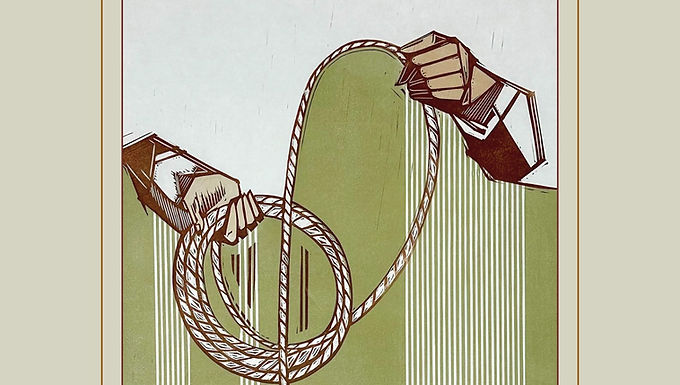
This April marked the one-year release of Sunni Brown Wilkinson’s book Rodeo, which won the 2025 Donald Justice Poetry Prize, and beautifully explores a mother’s grief and healing from loss. Her close attention to image and form in this book have inspired me in quiet moments, and—in conjunction with some of my own recent turmoil over finding the mental space to write—prompted me to ask her about her life as a writer and mother. (This interview was conducted over email—because as moms and introverts, that’s what worked for us.)
Elizabeth Cranford Garcia: I’d like to start with a personal question and ask you about the different phases of your life as a parent of young children, versus teenagers, as a grieving mother after the loss of your son, and how that’s affected your writing practice, and output. I’m thinking of “So Long,” which really resonates with me (and what my own book speaks to), describing that phase I think that mothers particularly go through, and which I’d like to quote here:
the eye of the eye
inside of me opens.
All the years of children
I loved and feared
would kill me.
[. . .] the dormancy of a wild
nner life I loved and knew well.
To survive, it left me. I cared then
for other wild things. Now in silence
it’s returning.
This captures so well that hunger for the self that I still regularly experience as a writing parent. I’m also reminded of a line that resonates with me from Victoria Chang’s collection With My Back to the World, which addresses depression: “a woman loses herself when she can no longer zoom out.” I’d like to hear what your writing experience is like in terms of that dynamic. Is that true for you? Do you still go through phases like this?
Sunni Brown Wilkinson: It was definitely more difficult to write when my kids were very young. I struggled with depression when I had a house of toddlers and felt my identity draining away. It was a sweet time of our lives as a family, but also exhausting for me personally. And yes, I identified very much with that Victoria Chang quote. I dealt with a lot of anxiety and self-doubt at that time, and I found a new empathy for creative women and what they sacrifice to be mothers.
Ironically, that was when I finally decided if I wanted a book, I had to make it happen, and the only time I could write in peace was very early in the morning. I woke up at about 5:00 or 5:30 and wrote until about 7:00 when I had to help kiddos get ready for school. Miraculously, I was able to cobble together a manuscript that finally had legs, revising old poems and pushing myself to create new poems. I did that for a couple of years and then sent it off and waited. That call from Black Lawrence Press changed my life.
By the time I got that phone call, however, we had just lost our fourth son and I was deep into grieving. That call was a spot of good news that really saved me. I do think I desperately needed that encouragement or I might have stopped writing in my grief. As it was, I dove into writing about my grieving process, my daily life, and this new phase our family was in. Then Covid hit and I actually had much more time to write. My boys were getting older and were pretty independent, Covid canceled all of our extracurriculars, and we practiced simplicity and attention to the local. That too saved me.
Overall, my output has been sporadic but, once I do write, deeply intentional. I squeeze in writing a few times a month. I make sure I always have a poem or two to submit to my poetry group. I ruminate on walks, think about my life and neighbors and friends, read at night, scribble when I can, jotting down on paper or the “Notes” section on my phone a phrase or image that surfaced and struck me. I record snippets of life that feel worth keeping, and I hold on to them.
I have much more freedom now than I did 10 or 15 years ago, and I wish I could go back and talk to my young-mother self. She was smarter and more capable than she thought, and that anxiety and fear of failure actually propelled her, so I guess it had its place too.
EG: Can you talk about what your writing practice looks like? Do you show up faithfully every day to write a certain number of words, or wait for inspiration to strike? Does it work best when you have an emotional need? I sometimes have a tendency to treat my writing like therapy—like I need that flow of images, that articulation of my emotional tension—but that also risks self-indulgence, so I’d love another perspective on this. What kind of conditions usually lead to your writing “flow,” for lack of a better word?
SBW: I do not write every day. Not even close. But I do write 2–3 times a month, and I scribble a lot in between. Part of me is always on the lookout for what strikes me as good material, and when I finally sit down to write, I generally have some notes to get me started.
Often times I find that I have ideas for poems when I am reading someone else’s poetry. Reading closely and immersing myself in certain language helps.
I understand your need for a “flow of images,” and mine tends to be more reliant on my emotional state. If I follow a random prompt and try to be interesting, my drafts are generally lame. I’m not good on the spot. I’m not very clever that way.
However, if I sit silently for a while and think about what I’ve been feeling, what has stuck to me lately, my haunts and obsessions, what relationships or scenes or rituals I’ve had at the center of me, refer to the notes I’ve been taking, and then try to capture those in images or phrases, I’m surprised by how quickly poems can come. Or they take a while but my draft gets me far enough that I have an understanding of what I’m trying to capture. A world opens up, and I follow.
EG: This book award, The Donald Justice Poetry Prize, requires a certain number of the poems to use traditional forms. And I thought that using forms for this subject matter of loss seemed very natural. I think forms can give us a way to move forward when we don’t know how to move forward. Were you consciously using forms to contain that grief, or did you end up seeing the formal possibilities as a poem was developing?
SBW: It was likely a mix of the two, but I did recognize early on that something as enormous as grief needs a container, some parameters, and that anything that haunts us (and grief is a kind of deep-hearted haunting) naturally relies on repetition. Elegy also leans into song, so sound devices, cadence, refrains, rhyme, etc., find their way in. Form poetry offers all of those in abundance, and they come with the structure already decided, which frankly is a relief. In deep grief, you’re already overwhelmed with decisions. It’s a gift to find a form that you know can drive an emotion or image all the way home, you just have to toy with finding the right words in the right order. It’s a bit of a puzzle and order during a time of chaos feels like grace.
EG: Is there a particular poem in this book that most helped you deal with your grief, or serve as a turning point for you? Or whose drafting or revising gave you some insight?
SBW: “Ghost” was a turning point for me. That came to me all in a moment when I was at my father’s house around a campfire in his backyard. I ran into the house, to his study, and wrote almost the whole poem in a few minutes. All but the ending, which came a couple of weeks later. I started to sense that I had more of those kinds of poems in me, maybe even a whole book. And I sensed too that each poem would be different, and serve a different purpose.
Incidentally, that final stanza is still the one I can barely read aloud. The other grief poems sit in what was once the present moment, which is now the past, and somehow that helps create a distance that feels safer for me. But that last stanza of “Ghost” refers to the future, and I’m still holding onto that heartache pretty tightly.
EG: Which was the poem that was hardest to revise, and what was that process like?
SBW: I had a few phrases of “When It Comes,” the final poem, in a notebook for about ten years. Originally, I put them in a poem about St. Francis of Assisi, but they didn’t feel right, and the poem itself never came to full fruition. But those lines kept nagging me, and I wanted to use them somewhere that set them off, that made them sing the way they did in my mind. So, when I found myself writing a kind of list poem about what to do when “the thing which I greatly feared ha[d] come upon me” (as Job says), those phrases landed right at home. Sometimes it takes a while for lines you love to find where they belong. The trick is to not lose them.
EG: Your collection is divided into two sections, “Bronc,” and “Chaps/Spur.” What made you decide on two sections, rather than three, an elegiac structure, which one might expect of this subject matter? Many of the poems near the end do feel like they console. I’m thinking of “Everywhere I Look I See a Rodeo,” where you follow this implied metaphor through your daily life—that you “fight grief the way the bronco / bucks that wily man on his back,” but also you “love the world like the buster’s hand / loves the horn of the saddle.” It’s a beautiful poem about seeing, and being able to see joy again. Can you share your thoughts on structuring the collection?
SBW: I knew going into it that I couldn’t possibly have a whole book of just grief poems. That wouldn’t even reflect the reality of our lives because, as much as we were grieving, we were also laughing and arguing and walking our neighborhood and doing everyday ordinary things. I wanted a collection that showed the movement of grief into appreciating the world in a new way, and it made sense to me to split the book into two halves. My original editor at Autumn House Press, Mike Good, noted that he’d seen many manuscripts with multiple sections or no sections at all, but very rarely one that was so directly bifurcated like that. I guess it was easier for me to think about grief and then grief recovery as two different things, and I found that the poems generally fell into one or the other.
EG: So many of these poems seem to bridge the gap between lament and love; they feel expansive and generous, even when they are mourning. I’m thinking of “Snow and Mud and Animal Bones,” especially the lines:
Prayer is like this: An animal
flattened, a language
we can barely hear.
I try. I’m trying.
he hardest thing to do is listen
to our own story.
I feel like these lines are both very direct and inward looking, but also including the reader in the experience. Do you find it hard to write about the intensely personal in a way that doesn’t feel self-indulgent?
SBW: Yes. Very much so. But I also find that the poems I gravitate towards the most are intensely personal. I interviewed Louise Gluck at Weber State, where I teach, back in the Spring of 2023, and in my preparation I read a lot of her work. I was reminded how deeply personal her writing is, maybe even "confessional" but with a voice that also felt universal, as if she was speaking for everyone but from her own perspective. To me, she has a primal, earthy, ancient voice, and she pairs her personal griefs with mythology, persona, metaphor to make them feel both individual and ageless. Her poetry, which I had read for years, and the poetry of Jane Kenyon, Lisel Mueller, Eavan Boland, and others, taught me the value of sharing the personal alongside the larger world. They’re both rich and wild, and using both in poetry does, as you say, “include the reader,” a reader who engages with the new (the poet’s life and language) while also being rooted in the familiar (the world we all live in).
EG: I’m very curious about your structural choices in “The Year We Considered Foster Care.” It seems to be a collection of notes in response to the requirements and advice for foster parents, and they scatter across the page using field form in a way that seems to mimic the process of planting and cultivation they describe. Can you speak to the creation of this particular poem?
SBW: That one is quite different structurally from the rest of my poems. And yes, you are right. The sections are more or less responses to the emails we received that year about how to be good foster parents. Honestly, some of those requirements felt impossible, and it made me respect even more the people who do foster. I would read those emails, record snippets, and then think about how well I would measure up. (Not well.) And I connected those to what was happening in my life at the time that showed my capacity (or incapacity) to have those remarkable foster-parent traits. That poem did feel more like a conversation between the state’s emails and my daily work, which at the time felt pointless. I think we all have years like that. This one felt like everything I planted died, my efforts to nurture creatures failed, my work was endless but never produced real fruit.
It’s by far the longest poem in the book because of that conversation, and I liked adding those caesuras and spaces to show uncertainty and exhaustion. A lot of the poem is in list form but instead of falling down the page it stretches across. I wanted it to engage with the precariousness I felt then, the long days and the big holes of my life, the reaching and the disappointments. I hope the lineation and stanza structures emphasize that. This was about a year and a half after we lost our son, and we were all still grieving, plus my kids were going through some new challenges, so ultimately we decided that fostering wouldn’t work for us, but I still ache a little thinking about that desire. That poem helped me talk myself through some hard things.
EG: I’d like to ask you, as someone from a shared faith tradition that privileges testimony—knowledge and certainty—do you feel sometimes that the particular certainties of our belief system are sometimes an impediment to the desire and honest inquiry that drives the poetic impulse?
SBW: Yes and no. I suppose spiritually I am most invested in the mystery of faith and God, of praying/talking to beings we can’t see and believing in graces and powers that so often look feeble or silly in our world. And poetry engages with mystery all the time and champions what is overlooked or overly simplified. Scripture—the New Testament most of all—reminds me that the language of real worship is akin to the language of poetry. Jesus himself used metaphors, imagery, repetition, and refrain to teach and to express his own love for his father. Nearly everything he said that is recorded in the New Testament sounds like poetry to me. I guess I lean on that more than anything. I don’t claim to be absolutely certain of many things—in or outside of religion—but I am sure that my love of poetry and poetic language is tied to my love of scripture. I think that’s where it started.
If you also mean “faith tradition” as in a religion’s culture, I have never really felt that I fit into our religious culture very well, so no, it hasn’t been contradictory to me that way. My poetry is about seeking for truth and beauty, and that’s no different than my spiritual seeking too.
Also, years ago I read a quote from Li-Young Lee about how he believes every good poem is about God, and that, though that may sound very narrow, his idea of God is very broad. That really resonated with me. I feel the same way.
EG: Is there any subject matter than you struggle to write about, that you have difficulty finding words for in a way that feels satisfying?
SBW: My mother and her mental health struggles have been subjects I have tried to write about since my late teens. I’ve published a few poems about her, and she has been gracious enough to allow me to do that (with one exception), but my relationship with her is so complex that I don’t think I’ll be able to write about it until after she passes. I’m in the thick of it still, and likely just too close.
EG: Could I ask you about your reading practice? What are you reading right now, and is it for pleasure, or curiosity? How often do you read poetry, and who have you read recently that has inspired you?
SBW: I suppose I read for both pleasure and curiosity. Right now I’m reading Dorianne Laux’s Life On Earth and I just finished her collection Only as the Day Is Long: New and Collected Poems. I swear I dog eared almost every single page. I read her for ideas on structure, for her language and imagery, for her difficult personal subjects, and how she handles those with honesty and grace. But I also love her work. It feeds me.
I’m also reading Corrie Williamson’s new poetry collection My Mother’s Bear Gun, which came out last year from River River Books. I had read some of Corrie’s poems online and was curious about the whole collection. It’s primal and wild and gorgeous, and has given me new ideas for structure and book arcs.
For pleasure, I’m reading The Unselected Journals of Emma M Lion and those are incredibly clever and absorbing. They’re reminding me why I knew I couldn’t write fiction.
EG: What are you working on right now that feels most exciting, that compels you to write?
SBW: I have a small collection of essays that I am hoping to turn into a larger collection, if I can just settle down and work on it. The trouble is that it’s so much easier for me to draft and revise poems. Poetry is difficult, but it generally takes less time to write, for me anyway. Essays are behemoth and more dauting to approach, though some subjects just work better in prose. I need to approach them in small steps; I just haven’t been smart enough to do that yet.
This essay collection has themes of neighborliness, community, and place. I didn’t plan that; it just happened. In prose, I tend to write a lot about the whole "love thy neighbor" adage and the ways I have loved and learned from other people. That feels really compelling to me. My husband says my essays are his favorite things that I write, so I guess I’d better knuckle down and finish them.
***
Rodeo, Autumn House Press, April 2025. 88 pp. ISBN-10: 9781637681022. U.S.: $17.95
Sunni Brown Wilkinson is a poet and essayist. Her newest book, Rodeo, was selected by Patricia Smith as winner of the 2024 Donald Justice Poetry Prize and was published in 2025 by Autumn House Press. Other books are The Marriage of the Moon and the Field (Black Lawrence Press) and The Ache & The Wing (winner of the Sundress Chapbook Prize). Her poetry has also been awarded New Ohio Review’s NORward Poetry Prize, the Joy Harjo Prize, the Association for Mormon Letters award in Poetry, and the Sherwin Howard Award. Essays can be found in Best of the Net 2023, Terrain.org, and New Ohio Review. She also co-directs a reading series in Ogden, Utah called Railtown Readings, which features celebrated writers of the West. Sunni teaches at Weber State University and lives in Pleasant View, Utah with her husband and three sons.
Elizabeth Cranford Garcia is the author of Resurrected Body, recipient of Cider Press Review’s 2023 Editor’s Prize, and Stunt Double (2016), a chapbook from Finishing Line Press. Her work has or will appear in journals such as Third Coast, The Florida Review, Southern Humanities Review, Tar River Poetry, Image, RHINO, Chautauqua, Rappahannock Review, Portland Review, and CALYX, and has been nominated for the Pushcart Prize and Best of the Net. She is an MFA student at Georgia State and mother of three. Read more at elizabethcranfordgarcia.com.
