INTERVIEW: Lisa Bickmore and Katherine Indermaur
Katherine Indermaur Interview with Lisa Bickmore, Utah Poet Laureate and Director of Moon in the Rye Press
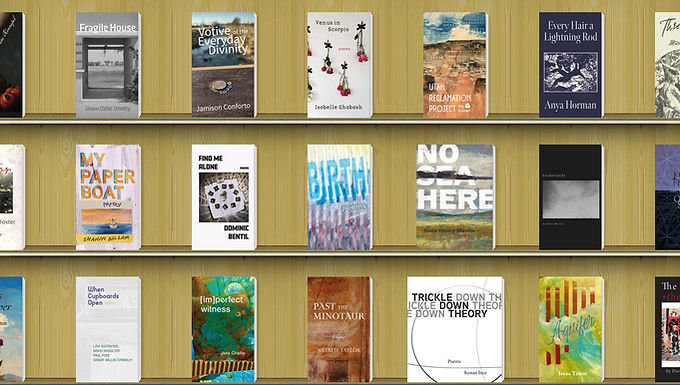
Katherine Indermaur: Tell me the story of Moon in the Rye, your mobile micro-press project! I know the name comes from a stunning line of Ken Brewer’s, former Utah Poet Laureate: “Fences never kept the moon out of the rye.” Where did the idea for the press come from? And how did you get started?
Lisa Bickmore: Without diving too deeply into the past, I started being interested in publishing when I was a faculty member at Salt Lake Community College (SLCC). At AWP one year, I attended a panel on publishing, and Anna Lena Phillips Bell of the University of North Carolina Wilmington presented on their publication center, Ecotone and Lookout Books. I found her presentation riveting, wrote to her and asked her for lots of very specific particulars, and proposed that SLCC found a similar center, where students could learn about publishing by being publishers themselves, of a series of chapbooks and broadsides. With the support of a number of administrators and colleagues, we built a wonderful center that many students have participated in, often building for themselves a set of versatile skills that could be deployed in any number of settings. This background was the foundation for Lightscatter Press, the nonprofit press I founded in 2021, focusing on multimodal publishing. And when I became poet laureate of Utah, the public project I proposed was what I call a mobile micro-press, with the goal of publishing micro-editions of chapbooks from writers in and around and from Utah. The “mobile” part of mobile micro-press comes from Agnès Varda’s film Visages Villages (Faces Places), in which she travels around France with a photographer, JR, who has a large-scale printer in a van—they take photographs of people in rural France, then print them and display them on walls or the sides of buildings, almost as installations. If only I could have a van! and a high-capacity printer and binder in it! For Moon in the Rye Press, alas, the “mobile” part is really more a metaphor for all the places the project reache—which, it turns out, is a good number of places.
KI: How else does Moon in the Rye differ from a traditional press and publishing model? Why do you publish chapbooks and broadsides specifically?
LB: Oh how I love chapbooks and broadsides! These two forms create multiple points of entry, for highly skilled people and near-beginners alike, and both have long histories of being print forms that found themselves in the hands of ordinary people. I will never forget visiting Special Collections in the University of Utah’s Marriott Library, holding a chapbook from the 1600s, bound with a simple pamphlet stitch, recognizing a print artifact that would have been possible to purchase in the early-ish days of print for two pence or something like that. Chapbooks now can have an artier profile, but they also have these humble roots. I liked that a writer at the beginning of their writing life could put together fifteen or so poems, more or less, and have a printed artifact, as beautifully produced as we could make it, to share with other writers, to take to readings, to connect with new writing communities, and so on.
The broadside project was specifically designed for the Academy of American Poets fellowship I was awarded in 2023-24, to work with children and young people, K-12, to write poems of engagement with Great Salt Lake. I worked with several hundred children, teens, and their teachers on this project. In each setting, we adapted to what was possible, given space, time, resources. I am so happy I got to do this project and have an authentic art-making experience with so many people.
KI: What is your hope for the people who get involved in this project: both the writers you publish as well as the students who help publish and publicize the work?
LB: When I proposed the micro-press, I did so with the belief that publishing is a part of creating and sustaining literary community. You can look far and wide through literary movements and see that publishing, in some form or another, is often a key part—it’s a way of making literary work visible, of sharing it through circulation, of giving it a life beyond more intimate spaces. I hoped to work with writing groups as well as individual writers, and I have been lucky to be able to do so. I worked with a group of writers in St. George, to publish Canyon Chorus—one of the first books we published. I also worked with a writing group in Helper, which had as its mentor the brilliant Nancy Takacs. I had the opportunity to work with the vibrant community writing with and for and in communion with Great Salt Lake, with nan seymour as a key orchestrator and muse. The result of this collaboration was irreplaceable, which features dozens of poems and hundreds of voices. All of these were existing writing communities—publishing the work that arose from those communities did the work of making greater visibility possible.
When I work with individual writers, my hope is to help them articulate for themselves where they are in the art of writing poetry: how do they strengthen their own practice as writers? Whom do they read? This is one of my favorite things about the work I get to do—these conversations with writers about their own writing. I offer, as an experienced reader, writer, and teacher, my own comments and feedback on the work they share with me, but my belief is that writers are self-designated, and I can affirm that self-designation with respectful attention and feedback. I have also heard some of the writers I’ve worked with talk about finding and sticking with new writing groups, which is enormously heartening to me. I hope that my work helps to strengthen literary community, and I see some evidence that it does, and has.
KI: Now let’s talk about some of the books Moon in the Rye has published and the community you create! You published Kenan Ince’s posthumous and only book of poems, Trickle Down Theory, in 2025, which Sugar editor Nano Taggart recommended in our last issue. I remember meeting Kenan at a Salt Lake City Public Library poetry reading organized by Joel Long back before the pandemic and thinking they were so impressive—a poet and a math professor! They seemed to be friends with everyone, and were such an integral part of the poetry community there. I was crushed to learn that they passed away in 2023. Can you tell me how this book publication came about, and a little about the book itself?
LB: I’m so, so glad to know that Kenan Ince’s work is finding more readers through this project. The manuscript came to me through the hands of Lance Newman, who was a colleague of Ince’s at Westminster, and who knew of their work. Lance asked me if this might be an appropriate project for Moon in the Rye, and I said yes, immediately, and with gratitude. Although I had never met Kenan Ince, I knew of them through friends, and I thought the manuscript was beautiful. We printed a few extra copies of this book—it’s closer to a full-length collection than a chapbook—because I felt that it might, through word of mouth, find more readers, and that has proven to be the case.
I was drawn both to the subject matter—evidence of a deeply curious, questing mind, its queerness and its ravishing language—but also to its gorgeous forms, which draw a reader into the poems. In the biographical sketch Newman wrote for the manuscript, he noted that Ince received many appreciative notes from students over the years, who noted the “passion and rigor” of Ince’s classroom, and, in another note, how Ince’s instruction made space for “the value of [sitting] with a problem you don't have an answer to, one which may not even have an answer.” These are great descriptors of Kenan Ince’s poems in this collection. I continue to be grateful to have had the chance to receive and publish this work. I love the cover design that our designer, Jem Ashton, came up with for this book—curving and extravagant and rigorous all at the same time.
KI: The poems of Natalie Taylor’s Past the Minotaur, also published last year, are powerfully unsettling myth reimagined in dramatic imagery and song, shot through with the anxieties of motherhood and womanhood. What do you love about this collection?
LB: I’ve been interested to see that a number of the writers I’m working with are working with myth materials, appropriation and reinterpretation, and Natalie Taylor’s book is, as you say, powerfully unsettling, and powerful in its own right. I love the way she positions her speakers so variously—sometimes voicing the godlike men, sometimes nameless girls and boys, sometimes the several named women of the minotaur myth—and does so so persuasively. And the lyricism of these poems is just unbeatable.
KI: Isaac Timm’s Aquifer (2025 also) is a forthright book of love poems and second-guessing, calling up everything from Guns N’ Roses lyrics to school dances to semi-trucks burning down at the side of the road. What made Aquifera good fit for Moon in the Rye?
Sometimes, people who know about Moon in the Rye will reach out and connect me to a poet that I need to know about. This was the case with Isaac Timm, whose poetry community in Logan, was passionate about his work. I felt so lucky that this happened! These are tough, observant and musical poems, nostalgic but not sentimental, that give the reader a privileged view of a youth and young adulthood lived in an unburnished but still beautiful light. There’s nothing else quite like this collection in the Moon in the Rye archive. Also, there’s “Logan Avenue,” a first-rate basketball poem, which I envy Timm for having written.
KI: Let’s talk a bit about your work as a poet, and the relationship between your writing and Moon in the Rye. How do you see your publishing work with the Utah poetry community as part of your vocation as a poet? Does one help inspire the other? Do they feed different parts of you?
LB: I feel that my work as a poet, and my own understanding of it, is always evolving. I spent nearly thirty years as a community college professor of all kinds of writing—those years were full of student writing, mostly in composition classes. Those years were also full of my own motherhood and family life. All of this relates to my life as a poet, and so are the spaces I helped to build where other writers could find their lives and relations as poets, or at least I hoped so. I feel so grateful that I’ve had opportunities to help build or amplify or strengthen writing communities. That’s how I see this work—as community building. My predecessor as Poet Laureate, Paisley Rekdal, told me once that she saw the laureateship as not so much a personal honor, but a public service. I know how many people are doing the good work of community building, and this is, for now, one of the ways I am doing it. All of this, to me, is a part of being a poet. I am still writing, I am still circulating my work, I am still a part of a writing group, bless them, I am still a working artist. And this publishing work is part of all of it.
KI: I love the cover of Rachel White’s The Velvet Earth After Rain (2024), which features an 1880 painting of the Great Salt Lake and nearby mountains by Gilbert Davis Munger. This ecopoetry is born of unique Utah landscapes, from the aforementioned lake to the desert redrock. Does Moon in the Rye take a local approach to the content of the collections it publishes, or just the poets who author them?
LB: I believe that what makes one a Utah poet constellates differently for each author. It can be a specific evocation of the Utah landscape, but it can also be a sensibility, a set of experiences—it can be almost anything. The collections are all a bit different in terms of how they articulate their Utah-ness. I loved reading Rachel White’s collection—ecopoetry, as you say, grounded in awareness of Utah and Utah landscapes at this specific moment. When we were working together in the manuscript consultation, I loved her refusal of pessimism, a value deep in the grain of her material. I think the collection gives beautiful voice to the necessity of paying attention and living close to the land. And what a beautiful title (and cover, absolutely)!
KI: Your 2024 chapbook Anathema was written by Sugar contributor Joe Roberts, whose review of Sandra Marchetti’s Diorama appeared in our last issue. Here Roberts conjures up otherworldly yet familiar Utah landscapes, much like White does in her chapbook. What kinds of things does Moon in the Rye do to support authors like Roberts through publication and after?
LB: Joe Roberts approached me—I think he may have been alerted to Moon in the Rye by his excellent instructors at Utah Valley University—with this manuscript, and it was a joy to work with him. I know that he has read in public spaces from the chapbook, and has sold copies to raise funds nonprofit organizations he supports. Moon in the Rye has had two public readings as part of the Utah Book Festival—I hope to feature Joe in a future event. One thing I see, anecdotally, is that, for our authors, publishing a chapbook, having it in hand, is a point of potential connection to the writing world. Authors of chapbooks have found writing groups or other writing communities, found ways to contribute to publications like Sugar, and found other writers to connect with. Because this is a community-based publishing endeavor, and because, in the end, it’s just me and designer Jem Ashton doing the work, in concert with our authors, promotion and circulation is collaborative, and the author carries much of the weight of that. I’m glad to have the digital archive of chapbooks on moonintheryepress.org, where readers can check out the work of all these fine poets. My budget—from the Utah Division of Arts and Museums funds—covers the initial micro edition, but authors often elect to purchase more copies to have on hand, and many of our authors find venues for circulation far beyond the original moment of publication.
I wish I could say a few words about each of our chapbooks and their authors—they are each original and unique. And each represents a person who has made writing—and learning about writing—a key feature of how they live their lives. We have six new chapbooks on the horizon, from Amanda Burr, Dominic Bentil, Andrew Martin, Susan Foster, Dana Henry Martin, and Shanan Ballam. There are another six scheduled for this budget year—and my publishing docket is already filling up for 2026–27, the last year of my laureateship. Stay tuned!
